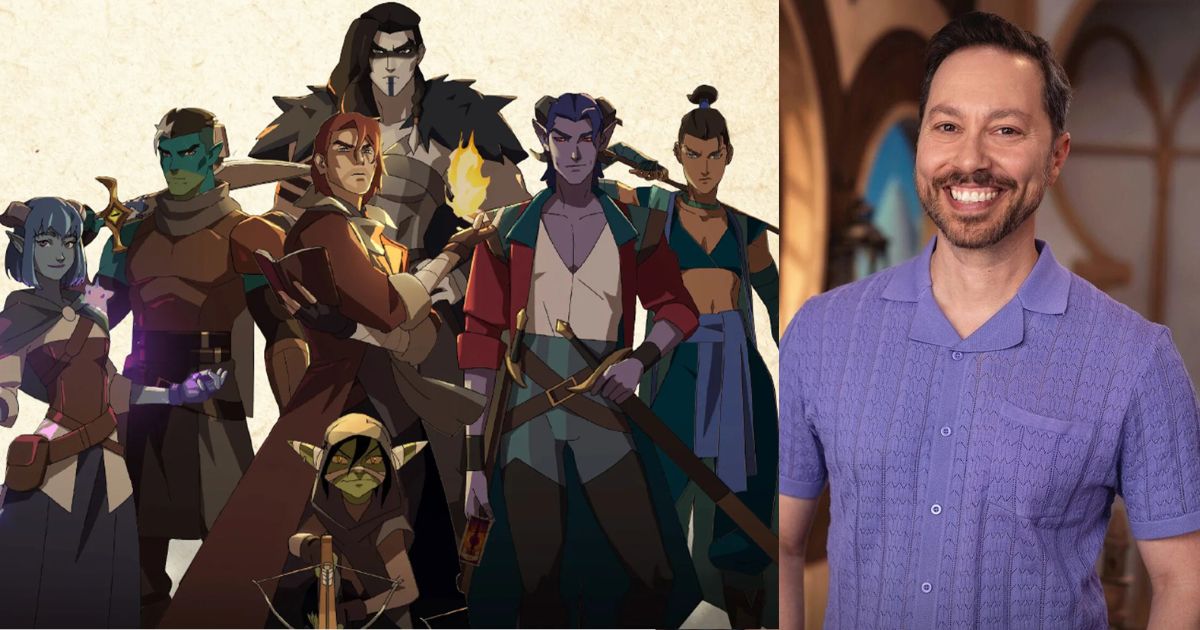
For Critters, The Mighty Nein holds a special place in their hearts. Campaign Two became a source of comfort and community during the pandemic, and now, seeing those beloved characters come to life in animated form has been an emotional experience for longtime viewers.
During a recent conversation with The Mighty Nein executive producer, writer, voice actor, and composer Sam Riegel, he talked about the unique musical identity of the new animated series, adapting fan-favorite moments, and how his experience of working on The Legend of Vox Machina helped shape the new series.
While music played a major role in The Legend of Vox Machina thanks to the bard Scanlan Shorthalt, Riegel explained that The Mighty Nein required a very different approach.
“Music is a big part of our storytelling, and it’s a big part of how we interact with our viewers and fans,” Riegel said. “We knew we needed some music in this.”
The series score was once again composed by Neal Acree, who also scored The Legend of Vox Machina, but Riegel noted that the overall sound of The Mighty Nein leans more electronic and less orchestral. As for original songs, Season One features only two, but each serves an important narrative purpose.

Finding the Right Voices
Among the standout musical moments is Marion Lavorre’s cabaret performance, “Who Will You Be?” in episode one. This number is truly special, as during the tabletop campaign a performance like this would be left to the theater of the mind. Now, thanks to the animated show, fans can finally see what a performance by Marion Lavorre looks and sounds like.
According to Riegel, the creative team worked closely with Critical Role DM Matthew Mercer to define what the Ruby of the Sea’s musical voice should sound like. “Matt had always described the Ruby of the Sea as a famous courtesan and singer and performer,” Riegel explained. “We knew that we wanted her to sing.”
The initial instinct was to create a jazz-inspired number reminiscent of classic stage musicals like Chicago. However, they quickly realized that grounding the song too heavily in a recognizable real-world genre would clash with the fantasy setting. Instead, Riegel and collaborator Peter Habib built the song on a jazz foundation while incorporating instruments from various cultures and historical traditions to create a sound that felt unique to Exandria.
For the role itself, they brought in Tony Award-winning actress and singer Anika Noni Rose (The Princess and the Frog), whose performance exceeded even the creators’ expectations.

Riegel revealed that Rose faced the additional challenge of performing in a fictional accent she had only recently learned. To help ease the process, the team recorded all of her dialogue before tackling the musical number. When it came time to sing, however, they encouraged her to prioritize emotion and vocal performance over perfecting the accent. “She just made it her own and really took what me and Peter had composed and elevated it to a whole new level,” Riegel said.
Another memorable musical sequence comes through Toya, the young performer whose song controls the Devil Toad. The production cast Auli’i Cravalho, best known as the voice of Moana, after deciding they needed someone who could sound youthful while also delivering powerful vocals.
“She sounds like a kid, and she can sing her face off,” Riegel said.
Unlike Marion’s theatrical performance, Toya’s songs needed to feel magical and otherworldly. The creative team processed Cravalho’s vocals with layered effects designed to make her voice sound as though it was being amplified by magic itself.
The result is both haunting and enchanting, reinforcing the idea that these songs are more than simple melodies and can be interpreted as spells that are capable of controlling a terrifying creature.
Riegel laughed while reflecting on the caliber of singers featured in the first season. “What an amazing couple of singers to put in our first season—a Tony Award winner and Moana.”
The list doesn’t stop there. During our conversation, Riegel realized that The Mighty Nein Season One also features voices connected to multiple Disney princesses, including Amy Carrero (Elena of Avalor) and Ming-Na Wen (Mulan).
“We’re trying to collect as many as we can,” he joked.
Beyond the Music
Aside from being responsible for the music, Riegel discussed how years spent producing The Legend of Vox Machina gave the team the confidence to push harder creatively with The Mighty Nein. “We’ve learned over the past three or four or five years of working on The Legend of Vox Machina so much about the animation pipeline,” he said.
That experience allowed the creative team to be more ambitious across every aspect of production, from larger-scale magical sequences to more nuanced performances and longer episodes. “The magic in The Mighty Nein is more ambitious. The soundtrack and score is more interesting and daring. The acting is more nuanced, the storytelling is more dramatic.”
For Riegel, that level of ambition stems from something deeply personal. In addition to voicing characters, he serves as an executive producer, writer, and composer for Critical Role’s animated projects.
When it comes to keeping the story faithful to the actual play campaigns, the cast remains heavily involved because of what these campaigns represent. “These stories are our legacy,” Riegel said. “These stories mean so much to us and so much to the people who fall in love with the characters and the universe.”
That passion, he believes, spreads throughout every department involved in production, from animators and editors to sound designers and composers.
As fans continue to speculate about future seasons, one recurring question concerns the iconic opening theme for Campaign Two. Some viewers wondered whether the beloved theme song “Your Turn To Roll” might eventually appear in The Mighty Nein animated series.
Riegel acknowledged the connection but explained that the song has become so closely associated with The Legend of Vox Machina that using it again could create confusion for audiences unfamiliar with the original livestream campaigns. Instead, the series utilizes another fan-favorite composition, “Welcome to Wildemount,” as part of its musical identity.
Still, he didn’t entirely rule out the possibility of hearing familiar themes resurface down the road. “As the storylines converge,” Riegel teased, “who knows? Maybe we’ll see a convergence of music as well.”
For longtime Critters, it’s yet another reason to be excited about what’s still to come. If Season 1 is any indication, The Mighty Nein isn’t simply adapting Campaign 2—it’s finding new ways to celebrate the characters, music, and world that fans have loved for years.