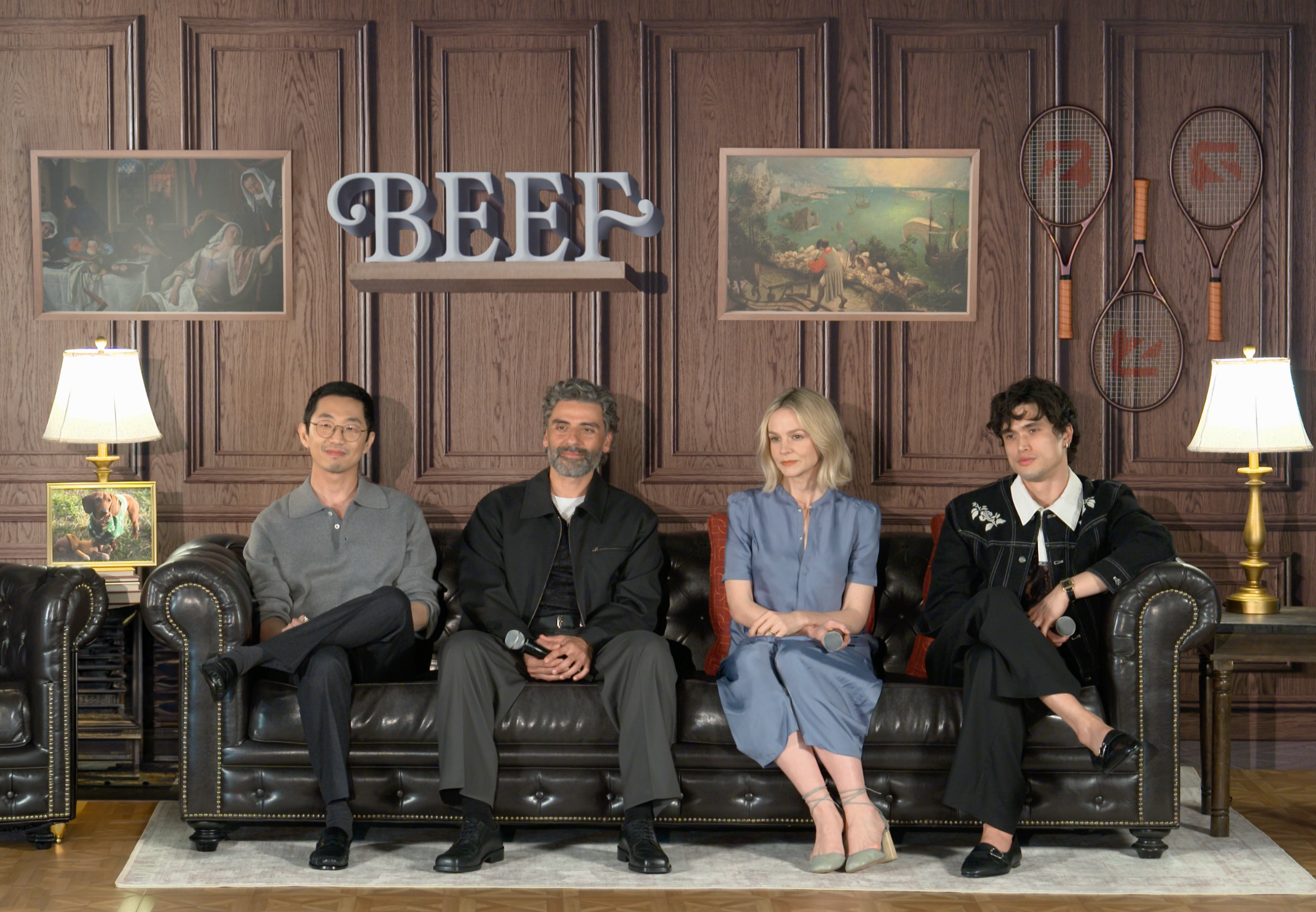
The award-winning Netflix series Beef is officially back! Season two is bringing an entirely new cast, a new setting, and an even deeper exploration of human conflict. At the global press conference, creator Lee Sung Jin (aka Sonny) and stars Oscar Isaac, Carey Mulligan, and Charles Melton opened up about what inspired the new season and what audiences can expect.
From real-life inspiration to generational clashes and even a standout canine co-star, here’s everything we learned from the “Beef” season two press conference:
1. Oscar Isaac and Carey Mulligan’s History Shaped Their Characters
In season two, Oscar Isaac and Carey Mulligan play Josh Martín and Lindsay Crane-Martín, a married couple whose seemingly perfect relationship is crackling beneath its facade. Isaac and Mulling have previously worked on “Drive” and “Inside Llewyn Davis”, making them the perfect choice to tackle roles that require explosive and emotional scenes. Isaac mentioned being excited at the thought of being able to act together again and reunite for the show in particular. Their work history and friendship gave the pair an advantage in making bold choices in scenes and fully committing to emotionally intense scenes.
OSCAR ISAAC: Being able to bring in to a certain extent, that history, that shared past, that lived experience, and to have so much trust already, you know, it kinda means everything in those situations because I knew that it would be an opportunity for us to just really be able to be bold together and know
that we had each other’s backs and weren’t protecting ourselves.
Mulligan added that working together felt effortless – so much so that it often didn’t feel like acting at all. Their preparation process, which included extensive rehearsals and conversations with Lee Sung Jin, made their performances feel more like a stage play than a traditional TV shoot.
CAREY MULLIGAN: It’s just so easy to act with Oscar because he’s not acting. You know, he’s able to feel like, you know, people can feel. You know, he’s very bold in all his choices, but none of it feels forced. It feels very natural. So I don’t ever feel like I was like, “Oh, we’re acting.” And I think because we had a sort of long lead-up, lots of conversations with Sonny, we had rehearsals, and when we actually got to shooting it, it felt like we’d sort of almost landed like a play, so much of our stuff, that it felt like doing a play.

2. The Story Was Inspired By A Real-Life Incident
Show creator Lee Sung Jin spoke about finding a story for season two, even though it hadn’t been picked up for another season at the time. However, it all changed when Lee faced a real-life incident that inspired the season’s story. He overheard a heated debate (much like the show) coming from a couple’s home, says the director/creator:
LEE SUNG JIN: The incident itself wasn’t that interesting, but it was everyone’s reactions to it where when I retold the story to my younger Gen Z peers, they were all kind of like aghast, clutching their pearls, being like, “Did you call 911?” Like, “Is everyone okay?” Whereas my, like, Millennial and Gen X peers were like, “Eh, big deal.” [laugh] And so that juxtaposition I thought was very interesting. And, you
know, once we had that, then we started trying to somehow convince this A-List talent to do my little show.
That contrast became the foundation for Season two’s central theme: how generational perspectives shape our understanding of conflict.
3. Season 2 Explores Identity in a Deeper Way
For Charles Melton, this season allowed him to explore and reconnect with his Korean heritage. The actor, who is Korean American, expressed that getting to film in Korea was especially meaningful. At the same time, his character Austin grapples with identity in a different way – caught between cultures and unsure where he belongs. Melton shared his own real-life experience, which Lee Sung Jin incorporated into the script. For example, there’s a line about his character being mistaken for another ethnicity that was pulled directly from the actor’s own experience.
CHARLES MELTON: In episode three, when Eunice, Austin, and Ashley are at the Chinese Bamboo House, and Austin goes, “Everyone thought I was Mexican.” You know, that was a personal sentiment that I shared with Sonny that he incorporated into the beautiful kind of soup of Beef.
Melton also talked about how collaborative the creative process was with Lee Sung Jin and about having the freedom to explore his character’s experience with idendity
CHARLES MELTON: I grew up in Korea for six years, and I really leaned into my Korean-ness, so to speak. You know, my mannerisms, I guess you can say. And, yeah, it was really incredible. And then, we see Austin kind of just like navigating. You know, he talks about how he’s never been around this many
Koreans before. And, you know, Ashley refers to him as Arizonian, opposed to Korean-American. So, you know, I didn’t have that experience as Austin. But for him to kind of meet his identity with both being Korean and American was, thank you to Sonny, and the voice, and kind of the space he gave me
as Austin to kinda just live in that.

4. The Millennial / Gen Z generational conflict
At its core, Season two is about the tension between generations. Oscar Isaac described this conflict as both relatable and universal. Older characters believe they’ve gained wisdom from experience, while the younger characters are still navigating life’s uncertainties, often without realizing their own blind spots.
OSCAR ISAAC: When it comes to the generational thing, you know, feeling like we were just those kids. And we can look back with judgment to them now that we know so much more about life. And yet, they’re totally blind to the way that they are behaving in the moment. And that’s also part of the joy of watching it, because I think we can all recognize that. We feel like, oh, now we know what’s going
on. ‘Cause we can look back. But with no sense of what’s coming in the future. And our future selves are gonna look back at our younger selves, be like, “Fuck, if they only realized, you know, where things were going.” So there’s a beautiful, compassionate view that happens throughout it too.
The show invites viewers to reflect on their own lives, recognizing that we all eventually become the people we once judged.

5. The Meaning Behind the Bees and the Ants
We saw crows used as a motif in the first season. In season two, the opening scene shows a trail of ants on the sand before Austin’s foot stomps down on them as he delivers drinks to the country club guests. Later, Austin attempts to save a bee inside the apartment.
Lee Sung Jin explains why they used insects as motifs in season two.
These insects represent hive mentality and collective behavior, tying into the show’s exploration of individuality versus conformity. Rather than spelling out the meaning, Lee Sung Jin intentionally leaves the symbolism open to interpretation, encouraging viewers to draw their own conclusions.
LEE SUNG JIN: I was trying to think about a motif for this season, and, you know, ants and bees kind of emerged. And I think there’s enough context clues in the show to hopefully allow the audience to come up with their own interpretation. But, you know, they’re a hive mind group of bugs. And the show is a lot about self versus other. And I think Chairwoman Park probably gives a speech that can kind of like shine a light on all that. But, you know, I think a lot of fun for us, a lot of the conversations we have is trying to figure out the right level of being not too on the nose, but, you know, not also, like, too esoteric and vague. And I’m finding that middle ground where the audience feels like they’re in good hands and can participate in the interpretation of the work. And I’m hoping the bugs, the ants, and bees are that.
6. Why the Montecito Country Club is the perfect setting for this season
This season moves the story into the world of a Montecito country club. Lee Sung Jin revealed that the setting was inspired by his own experience visiting an exclusive club, where he noticed a stark divide: wealthy, older members contrasted with younger employees working behind the scenes.
That dynamic can be seen as a parallel to modern society, highlighting themes of wealth disparity, privilege, and the growing frustration among younger generations who feel locked out of opportunity.
LEE SUNG JIN: I found that to be a great microcosm for society because, you know, no matter how hard those employees work, they’re never gonna become members. And, you know, like Austin says in the show, “Everyone grabbed the bag before we could,” which is, I think, a sentiment that is growing more potent by the day due to leaders continually stripping away the checks and balances that used to be in place for capitalism. So, you know, once we had that metaphor, we kind of ran with it.
Melton chimes in playfully, quoting a line from the show:
CHARLES MELTON: Did you know the 16-piece at KFC is $52.99 right now?
LEE SUNG JIN: Capitalism.
7. Lee Sung Jin’s Dog Stole the Show
Finally, one unexpected highlight: a dog named Jones.
Jones is Lee Sung Jin’s dog in real-life, and steals every scene he’s in. According to the cast, Lee couldn’t stop praising the canine actor. much to the playful frustration of Isaac and Mulligan.
LEE SUNG JIN: The cast was saying that I gave more compliments to Jones than I did the cast.
CAREY MULLIGAN: Yeah, first day of our shooting. You’ll see that. Oscar and I spent the entire day going, “Does Sonny like it? Is this sort of what he meant? This is right, right?”
The director wasn’t given the actors much feedback, “Not saying anything,” remembers Oscar Isaac.
CAREY MULLIGAN: “He’s not saying anything. Is he laughing? Are we funny? Is this meant to be funny?” Like, we spent the whole day second-guessing ourselves. The dog is on set like two days later, and he’s like, “Jonesy’s a good boy. Jonesy’s so good. Ooh, Jonesy,” you know.
LEE SUNG JIN: I mean, that’s what was going on in my head about you, but then it’d be so patronizing for me to tell the great Oscar Isaac and Carey Mulligan.
Isaac and Mulligan teased Lee about wanting to get the same compliments as Jones. “I would’ve loved it,” said Carey.

If season one of “Beef” was about explosive conflict, season two seems to dig even deeper by exploring the systems, identities, and generational divides that fuel those conflicts in the first place. With a powerhouse cast, layered storytelling, and a sharp focus on modern society, this new chapter is shaping up to be just as compelling.
Beef Season 2 premieres on Netflix on April 16.
What Is Beef Season 2 About:
A Gen Z couple witnesses an alarming fight between their millennial boss and his wife. Ashley (Spaeny) and Austin (Melton), both lower-level staff at a country club, become entangled in the unraveling marriage of their general manager, Josh (Isaac), and his wife, Lindsay (Mulligan). Through favors and coercion, both couples vie for the approval of the elitist club’s billionaire owner, Chairwoman Park (Youn Yuh-jung), who struggles to manage her own scandal involving her second husband, Dr. Kim (Song Kang-ho).