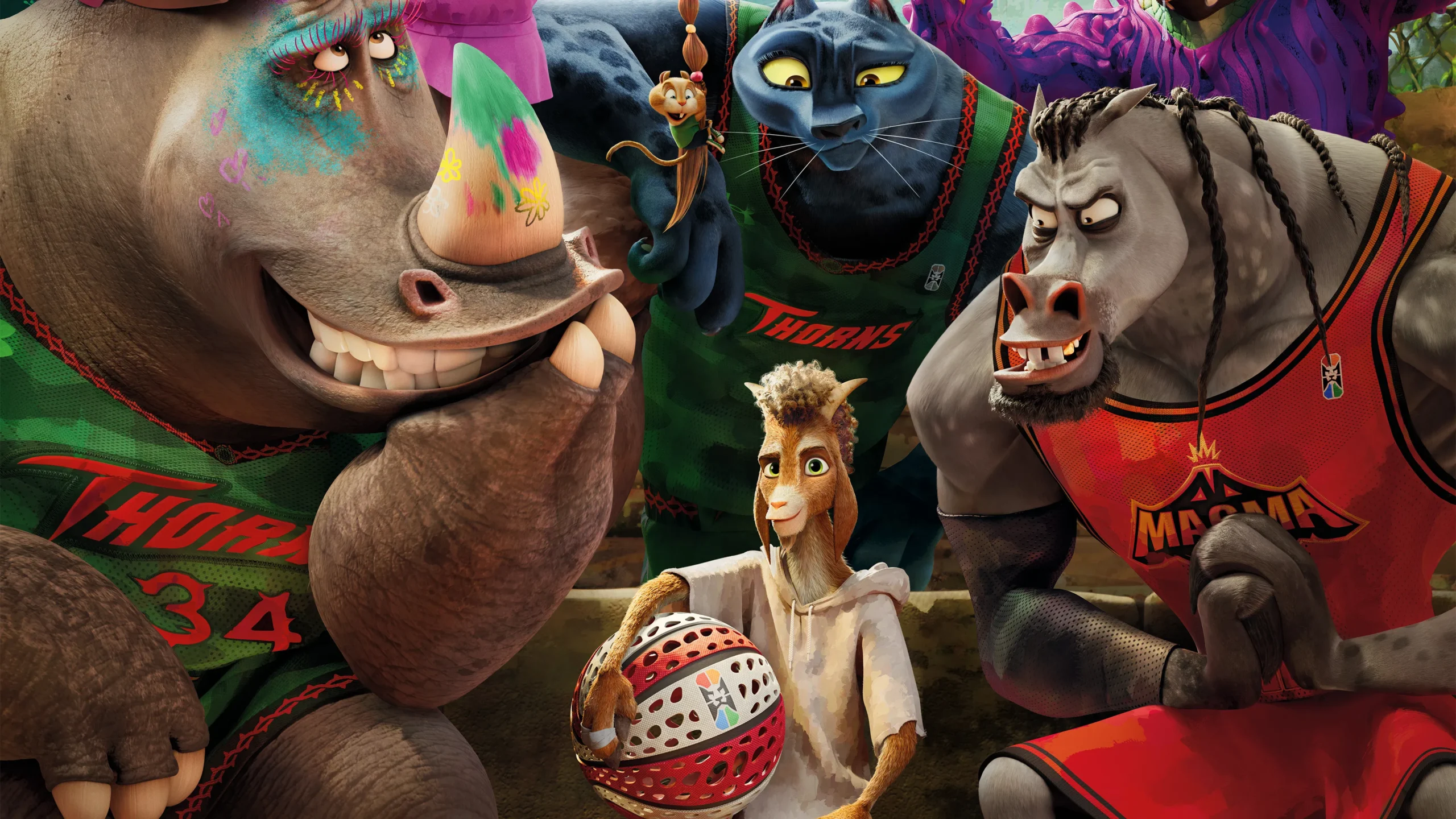
Sony Animation‘s upcoming animated feature “GOAT” takes basketball to a new level! This story takes place in an all-animal world, where a small goat named Will decides to go big for his ultimate dream – to play pro roarball! The Movie Couple was invited to go behind-the-scenes to learn more about production and character design, how the animators craft the action sequences, voiceover, and of course, an early screening of the movie! The press day ended with a Q&A with director Tyree Dilihay, co-director Adam Rosete, and producer Michelle Raimo-Kouyate
The story is inspired by real-life GOAT Stephen Curry, as the character Will’s journey parallels Curry’s own. The character design of Will, as well as his shooting form, is also inspired by Curry. The basketball star also serves as a producer and the voice of Lenny in the film.
The official synopsis for “GOAT”:
From Sony Pictures Animation, the studio behind Spider-ManTM: Across the Spider-Verse and the artists that made KPop Demon Hunters, comes GOAT, an original action-comedy set in an all-animal world. The story follows Will, a small goat with big dreams who gets a once-in-a-lifetime shot to join the pros and play roarball – a high-intensity, co-ed, full-contact sport dominated by the fastest, fiercest animals in the world. Will’s new teammates aren’t thrilled about having a little goat on their roster, but Will is determined to revolutionize the sport and prove once and for all that “smalls can ball!”
Authentic Basketball Plays
Discover how the film’s action sequences came to life, from storyboards with head of story Keely Propp, through a new previsualization pipeline led by head of cinematography John Clark.
To accurately and authentically portray basketball in animation, the team starts with storyboards and pre-viz. This is truly a team effort, as the animation must match the characters’ storyline, relationships, and even the court they play on. Head of story Keely Propp and head of cinematography John Clark talked about working with NBA legend Andre Iguodala to consult on bringing authentic basketball plays to life.
“[Andre Iguodala] really brought the authentic pro baller experience to the DNA of the film. And to choreograph the X’s and O’s, the director walks Andre through each play of the game, they brainstorm storyboards, they tell them about the story when they had to happen in there, and then give them the piece that he needed to hit. And then he’d go through this massive library of NBA plays in his mind and really quickly pull down the perfect one for each one of the plays,” says John Clark.

We were shown a behind-the-scenes clip of Iguodala pulling a play directly out of The Warriors’playbook- the cyclone, which was used in the film.
The animators used 3D-printed miniatures to stage the play and accurately animate it. “We would take Andre’s Xs and O’s, as we call them, his choreography, and then we just stage it out very simply, and this is what we call the chess piece pass, enables us to work out an overview of the motion of all ten players on the court and give the directors a chance to take adjustments before we start our animation pass”, says Clark.
When you see these moments playout on screen, know that it is all authentically crafted to match real-life plays.
The Fashion of “GOAT”
Just because the characters are playing Roarball doesn’t mean they’re only seen in workout attire and team jerseys. Costume designer Dominique Dawson took us through all the different looks in “GOAT”, from activewear to tunnel walk fashion. The characters in the film aren’t always walking on two legs. Due to the physicality of roarball, the characters will switch from playing standing on two legs, to playing on all fours. Dawson also took this into consideration during the design process.
“Once I could kind of wrap my head around the actual anatomy of the animals, then I knew I had to build a serious deck of streetwear so that all of the illustrators and our creative team here really had an understanding of like what’s possible,” says Dawson.

Dawson also considered each character’s personality and motivations. Take Will, for example: who knows he’s seen as small, so he tries to appear bigger through his clothing. Dawson used layering pieces to bulk him out a bit to give him more confidence. With Thorns’ star player Jett, who already had confidence, Dawson leaned into a power suit that showcased her strength and physicality.
Fashion pieces often associated with basketball, such as sneakers, and the culture around sneaker collectors also played a significant role in costume design.
Character Design and World Building
To build out the world of “GOAT”, production designer Jang Lee, art director Rich Daskas, and motion graphics effects Dylan Casano gave us a detailed look at the film’s unique visuals and arenas.
Production designer Jang Lee spoke about bringing the intensity of the court to animation, and the process of lighting the environment as well as the characters, “We brought hard lighting and also very vivid textural, and also the sculpture quality to look at the characters, so we’re trying to showcase that they are the athletes, they’re the true actually living characters, and also, it’s really brings all the details on the front and very close to camera, it was very immersive when you watch.”
When asked which character was the most challenging to light, Lee answered “I think that’s feathers is always hard, ” speaking about Olivia Burke, the ostrich. “We’re going for a painted look, and the feather is usually the hardest. So we kind of have to maintain the overall shape and feather details.
Art director Rich Daskas talked about the world feeling “lived in”and making it feel more urban. “We wanted it to feel like they live in the world and they get dirty, they get sweaty. It’s humid. There’s always, if you look at the night stuff, there are bugs flying around the streetlights. There’s always stuff floating in the air.”

This was the approach the designers took to the different arenas showcased in the film, which also reflects the region they’re in: ice, magma, caves, mountains, jungle, and so on.
Trading cards were also an important element in the film, and graphics effects artist Dylan Casano took us through the process of creating it in animation. “First, we started by deconstructing the basketball card. ‘What makes the aesthetic tick,’ right? How do we boil this down to its individual components? The hollow foil, we have the foil stamped lettering with the grid up there. And then we collected all these. We made a library of these textures shapes and patterns that you see in these basketball cards, when you hold them up to the light, you know, with like that iridesence that they have. And so on the bottom here, you can see, this is a sort of arc recreation of the real-world basketball card, kind of shapes and stuff, and this is what we used in the designs.”
Inside The Editing Room
The animation editing process is a long, deeply collaborative journey – one that begins at the very first pitch and continues all the way through the film’s final premiere. For this production, that journey spanned more than three years, with editor Clare Knight and directors Tyree Dilihay and Adam Rosette working closely from development through final quality control.
“What we did was we had an audience look at it, and what we were finding funny, they didn’t seem to. And we realized, ‘Okay, maybe he’s a bit too mean, and maybe he’s not a great cutthroat.’ So what’s great about animation editing is we don’t have to go out and reshoot. We don’t have to get a crew, we don’t have to wait for the footage. In my edit bay, you know, Tyree and Adam started pitching at what’s the next level. The information we got from the audience is that they really responded well to all the animalistic aspects of each of the characters. So that’s one thing that we were adding to the story,” says Knight on the editing process of the particular scene.

The collaborative nature of animation extended throughout the entire production. As the film progressed, animators added subtle visual details that sometimes required editorial to adjust timing or pacing to let moments breathe. “It’s a constant back-and-forth,” the editor said. “That’s why I love animation — it’s so alive and responsive.”
Among the most challenging sequences were the basketball scenes and the climactic final game, which required careful choreography, timing, and emotional payoff. But the heart of the film, they noted, lay in the emotional backstory surrounding Will and his mother.
“As someone who lost their mother very young, that storyline meant a lot to me,” they shared. “We tried many versions, but what stayed consistent was the idea of memory — photos, home movies, little glimpses that tell you everything without spelling it out.”
After three years, the experience proved deeply rewarding. “This film taught me so much, and working with everyone on it was a joy from start to finish.”