The upcoming Netflix animated feature Ray Gunn has taken award-winning director Brad Bird decades to make.
Director Brad Bird first conceived the animated feature roughly 30 years ago, long before the film’s distinctive blend of film noir, sci-fi, and retro-futurism could finally make its way to the screen. While the project evolved over time, Bird says the core of Ray Gunn has remained consistent. “The stuff that people are gonna think is really current, it was in there a long time ago,” he explains.
After years of trying to get the project made, Bird eventually returned to the script and found a path to bring it to life. The result is a film that embraces its vintage influences while creating a world that feels distinctively its own.
Long-time collaborator Michael Giacchino joins Bird on the journey. Their creative partnership dates back to Pixar’s The Incredibles, and Ray Gunn gave the pair another opportunity to build a film’s identity through the combination of animation, storytelling, and music. For Giacchino, that meant developing a score that would balance film noir, big-band sounds, and sci-fi-inspired sounds while serving the story.
During a Q&A at an early press day, the duo also discussed the creation of Venus Nova’s music with singer/songwriter Kimbra, the philosophy behind Ray Gunn’s character designs, the inspiration for Eyera’s camera-like design, and why Bird believes imperfections are essential to making animated characters memorable.

You’ve had this for around 30 years, as a script or an idea. How has it changed over the years?
Brad Bird: It’s definitely changed as every project does change. I can’t think of one that I’ve done that didn’t change until the final mix was shipped. I mean, I’ve been rewriting dialogue on some films at Skywalker, and rewriting a line that somebody says or something like that and just barely getting it under the wire. So there were those kinds of changes.
But fundamentally, no. The stuff that people are gonna think is really current, it was in there a long time ago. It just was either ahead of its time or pessimistic about where we were headed. I don’t know. But anyway, no, fundamentally it’s the same movie.
What is it like working together again?
Michael Giacchino: It’s always the best. I mean, always the highlight of my year is when I look and I can see on my schedule that there’s gonna be a Brad Bird movie coming up. I mean, in this movie, I read this script, like in 2009, I think, the first time. I still remember the chair I read it in. I actually, I remember just thinking, cause I’m like, oh my God, this is gonna be great.
Brad Bird: The most fun part of the process to me is bringing the film, which feels relatively complete at that point. And then the very scary process of ripping out this music that has sort of been Band-Aids on Band-Aids. It’s like eight inches of Band-Aids. And you feel like, well, that’s secure. And then you kind of throw it away, and Michael makes it this beautiful, consistent.
And just sitting there and watching that process happen is the highlight of every film that I’ve worked with him on. Cause he’s great. He dials right into the movie that we all wanna make. As soon as I hear it with the film, I’m like, that’s the way it had to be. It’s absolutely what I want.
Michael Giacchino: He’s always handing me the movie, reluctantly, because he’s been working on this thing for years and he knows that I’m just gonna rip everything out.
Brad Bird: The amount of power composers have that late in the process is mind-numbingly scary. And the thing is, is that he rebuilds it into a much stronger, much healthier being than I could have ever imagined. But it’s always right at the end.

The two famously worked together on The Incredibles, and Giacchino shares the story about landing the job and how their first collaboration taught them about the relationship between music and storytelling.
Michael Giacchino: When I first got The Incredibles, I had been waiting for weeks to see if I was getting that job. It was my first movie. And so, understandably, I was sort of like, I just really wanted to do that movie so bad, but also felt like they’re never gonna hire me because they worked with Thomas Newman and Randy Newman and these guys and they would never do this.
But for whatever reason, they did. And he got on the phone with me to tell me I got the job. And literally the first thing he says out of the gate is, “Now listen, your music could ruin my movie.”
Brad Bird: If you and I are not on the same page every step of the way, the audience is gonna start thinking things we don’t want them to think. They’re gonna start feeling things we don’t want them to feel. So it is so important that you and I are clasping hands the entire process to make sure that this story is right. We’re both telling the same story.
Michael Giacchino: Music is such a dangerous weapon. If a composer is on a project to write music and not to tell a story, that’s a problem. That’s a big problem. And I’ve always been attracted to projects where I could help tell the story.
Brad Bird: Michael is a chameleon.
The inspiration for Ray Gunn came from The B-52’s song Planet Claire. Did you give Michael anything else to listen to?
Michael Giacchino: I mean, for me, it was more about listening to, or I had listened to in the past, growing out of 25 years, I became obsessed with a lot of radio plays and stuff like Johnny Dollar and different things. Like crazy old investigator things, The Shadow, all of this, all of this. I listened to those incessantly. And a lot of my heroes worked on those things. Jerry Goldsmith worked on a lot of that stuff. So for me, it was more about that because I think in terms of the Planet Claire thing, that was always something you had in the opening.
Brad Bird: What is there in the Planet Claire thing, which is what made me come up with the idea, or the name Ray Gunn, which made everything else happen, was juxtaposing the sort of big band swagger (7:19) of film noir, some film noir scores, with the woo, you know, of like 50s monster movies, that were Day of the Earth Stood Still, stuff like that.
It was those two things kind of bumped up against each other. That was, in its most basic way, that was the movie. So he clicked into that in a second and brought in a lot of other influences.
Michael Giacchino: It was basically just fun trying to create, what does modern noir sound like? How do we do that?
Brad Bird: Retro future.
Michael Giacchino: Retro future modern noir.
Brad Bird: I just added words to it. But, you know, again, with all of that, it’s like very heady things to think about, and it really just comes down to what works with the story as you’re writing. You know, it just comes down to that.
How did the sound overall for the film combine with your vision for Venus Nova?
Brad Bird: One of, over the course of time, it’s its own story, but one of, a friend of mine who’s a wonderful animator and was one of the animation supervisors on Ray Gunn kept going, ‘There’s this artist named Kimbra. You gotta hear Kimbra.’
And I’d be like, ‘Why? Why, what do I need?’ ‘You just have to.’ And finally, I listened to an album that she did, and it was great, and when I realized that this thing was actually gonna get funding, that we could go to her and have her write the Venus Nova songs.
So, Michael and I very early met with her and started talking about what kind of songs we needed for the movie, and it was really interesting because I could be unbelievably specific.
Like, I could say, ‘Okay, I want you to write an earworm, something that instantly becomes like, on your mind, but I want it to be slightly annoying. You know?’ And I said, ‘But it has to be, instantly, you find yourself singing it.’
And so, she just kind of went, ‘Okay, got it,’ and came back and gave me this song that was, as she would call it, ‘a banger.’

Speaking to the retro-futuristic world of the film. How did you make sure it felt like its own world rather than simply borrowing from other films?
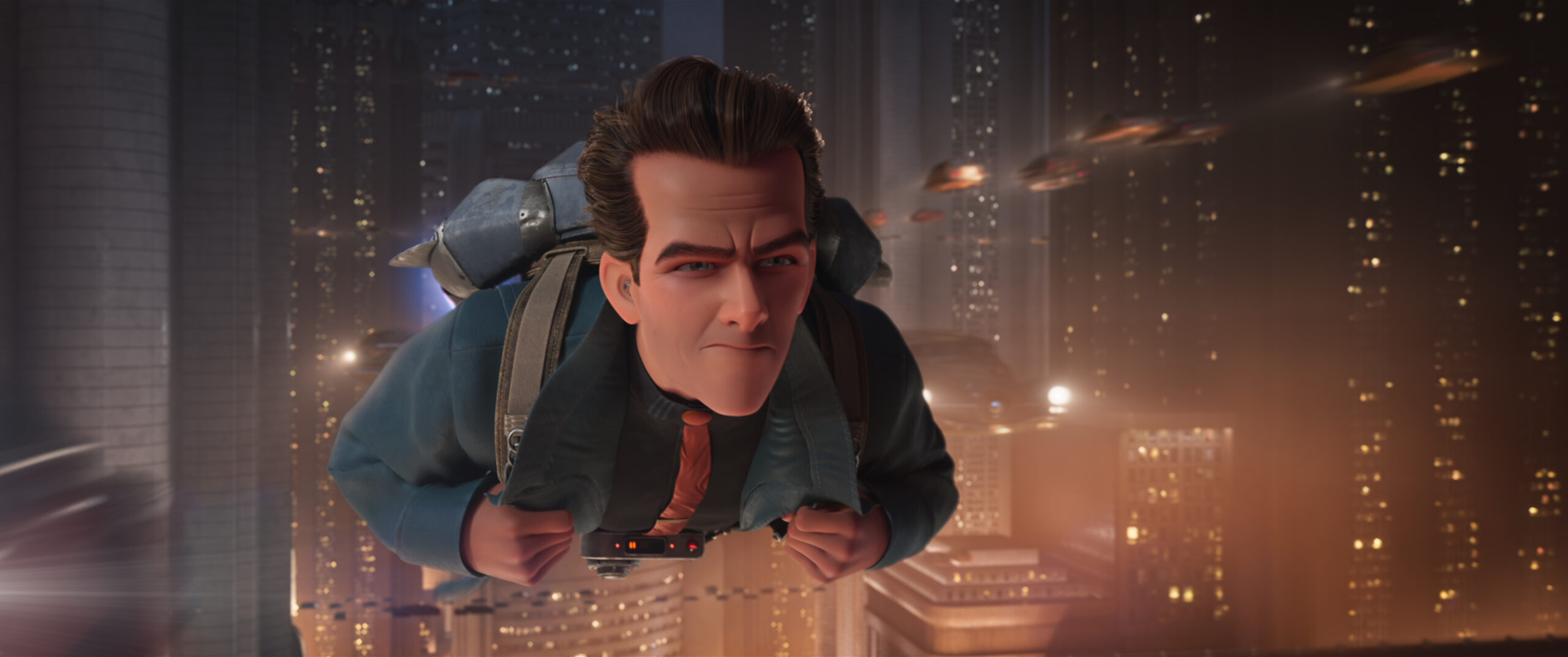
Brad Bird: One of the things that’s weird is that I watched other films do some element that I thought we were gonna be first at, like, okay, now someone has used jetpacks, okay, now someone has used, and over the course of 30 years or whatever, each one, like, okay, now somebody did that, now somebody did that, so everybody’s gonna think I’m copying these other things, but in fact, we were doing it first if somebody had backed it back then.
It’s just that we had all of the stuff under one roof, and we still do. It’s just that people are gonna think that I’m reacting to the other films when, in fact, it was written in the script way long ago.
What was the guiding principle for Michael when creating the score?
Michael Giacchino: It was a little like Ratatouille in the sense that it was, all right, whatever you can grab that’s in the room that works and fits into that mold, use it.
Sometimes weird things work. Because there’s a lot of synths in this, there’s also a lot of, like, a very string-based sort of Maltese Falcon feel to what’s going on, there’s a lot of the sax and sort of big band, but I also didn’t want it to feel like The Incredibles, I wanted it to do kind of a different thing with that.
There was one thing that needed sort of a bossa nova thing, and he was like—
Brad Bird: Yeah, that’s where I live in my brain.
Michael Giacchino: So it really, it was a lot of options to be able to pull, and then it was just about balancing them. How do you, it’s not too much of this, not too much of that, keep it all under one roof. And how do you do that, basically, it’s just thematically coming up with a theme that you can then twist and bend and do all kinds of things with. And in this film, there are pretty much two main themes, there’s sort of a love theme, and then there’s the main theme, there’s the detective theme.
Brad Bird: There’s an Eyera theme, too.
Michael Giacchino: There’s an Eyera theme, too, for all his stuff that he has to go out and do as well. And I think of that as like their partner theme in a way. But if you take those themes, and then you keep them consistent story-wise, and they’re following the story, you lay them against the story, it usually is the true North Star.
Brad Bird: Well, and you get nonverbal connections that are great, where you don’t have to say anything, but the music puts the connection down between something somewhere else in the film, and it becomes this living thing.
I think that’s what he’s really great at, is this idea of, it is so much better to show something than to tell you something. And exposition is as wieldly a weapon as music can be, and if it’s too heavy, if there’s too weighted to exposition, you get bored. To be able to show exposition as opposed to, say, exposition, that’s the trick.
About Ray Gunn
From director Brad Bird (The Incredibles, Ratatouille) comes Ray Gunn. Set in Metropia, a city in an alternate future as seen from 1939, private investigator Rayond Gunn (voiced by Sam Rockwell) is drawn into a case involving aliens, murder, and mega multimedia star Venus Nova (voiced by Scarlett Johansson).
In addition to Sam Rockwell and Scarlett Johansson, the cast also includes Tom Waits, Alan Tudyk, Matt Berry, Bobby Cannavale, Michael Chernus, Kether Donohue, Michelle Rodriguez, Aasif Mandvi, Matt Jones, Kathryn Hunter, John Ratzenberger, Justin Peck and Patton Oswalt